

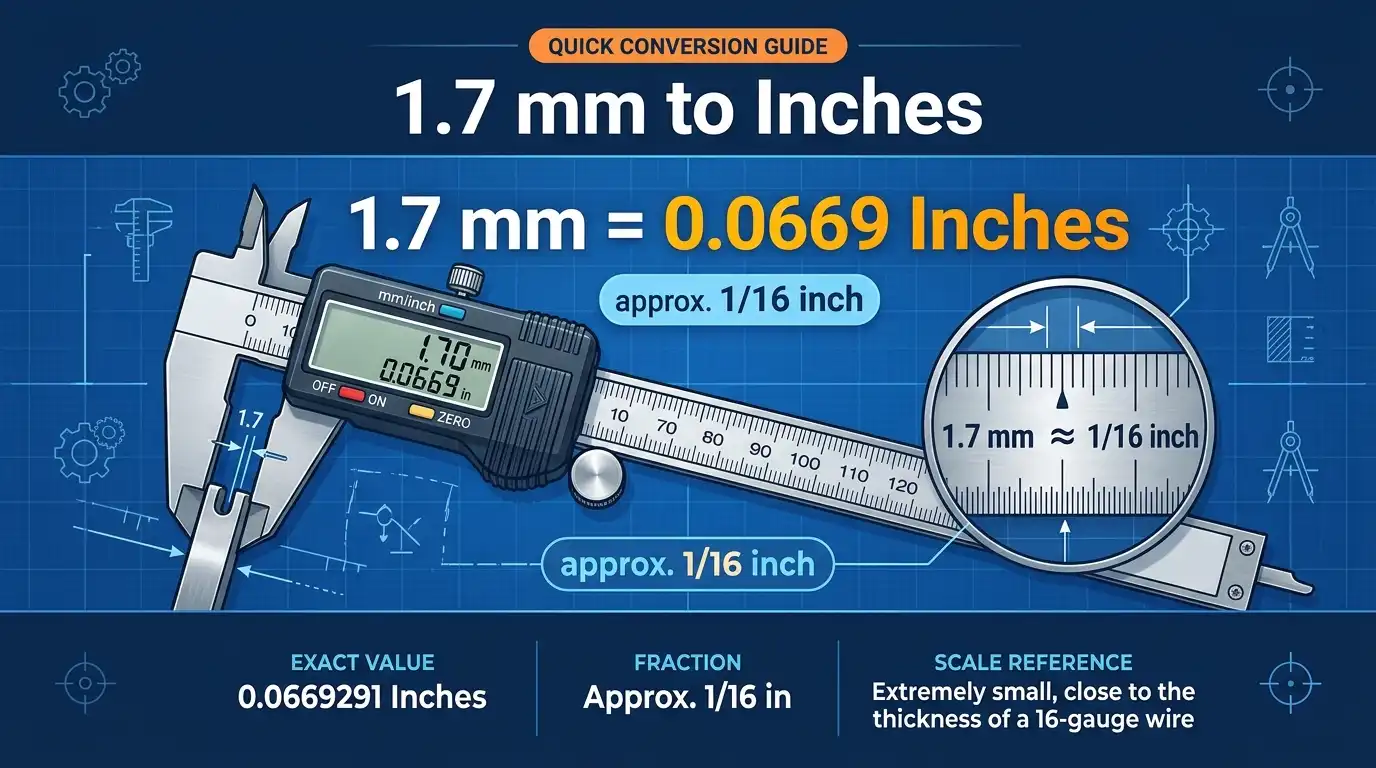
1.7 millimeters equals approximately 0.06693 inches. If you need a quick answer, 1.7 mm is a little less than 0.067 inches.
Millimeters and inches are both units used to measure length. Millimeters belong to the metric system, while inches are part of the US customary and imperial systems. You may need to convert millimeters to inches when measuring small objects, checking product sizes, working with tools, or reading technical drawings.
The conversion is simple once you know the correct formula. You only need to divide the millimeter value by 25.4 because one inch equals exactly 25.4 millimeters.
This guide explains how to convert 1.7 mm to inches, how to check the calculation, and how this measurement compares with nearby values. It also includes a conversion table and answers to common questions.

Quick Answer: 1.7 mm in Inches
Here is the conversion for 1.7 millimeters:
- Millimeters: 1.7 mm
- Inches: 0.0669291339 inches
- Rounded to four decimal places: 0.0669 inches
- Rounded to three decimal places: 0.067 inches
- Fractional inch: Approximately 1/16 inch
The exact decimal result continues beyond the digits shown. The value above is rounded for practical use.
Remember that 1/16 inch is approximately 0.0625 inches, so it is close to 1.7 mm but not an exact match.
How to Convert 1.7 mm to Inches
To convert millimeters to inches, divide the number of millimeters by 25.4.
The formula is:
Inches = Millimeters ÷ 25.4
Now put 1.7 into the formula:
[
1.7 \div 25.4 = 0.0669291339\ldots
]
Therefore:
[
\boxed{1.7\text{ mm} \approx 0.06693\text{ inches}}
]
This is the standard conversion from millimeters to inches.
Step-by-Step Calculation
You can follow these three steps to convert 1.7 mm to inches.
Step 1: Write the measurement.
Start with 1.7 millimeters.
Step 2: Divide by 25.4.
Since one inch equals 25.4 millimeters, divide 1.7 by 25.4.
Step 3: Round the result if needed.
The result is approximately 0.066929 inches. For most everyday uses, you can write it as 0.0669 inches or 0.067 inches.
Keep more decimal places when you need greater precision.

Why Do You Divide by 25.4?
The number 25.4 comes from the exact relationship between inches and millimeters.
1 inch = 25.4 millimeters exactly.
This means an inch is much larger than a millimeter. When you convert a small millimeter measurement into inches, the numerical value becomes smaller.
For example:
- 25.4 mm = 1 inch
- 12.7 mm = 0.5 inches
- 6.35 mm = 0.25 inches
- 1.7 mm ≈ 0.06693 inches
You can also check the answer by multiplying the result in inches by 25.4.
[
0.0669291339 \times 25.4 \approx 1.7
]
The result returns to about 1.7 millimeters, which confirms the conversion.
Is 1.7 mm the Same as 0.07 Inches?
Not exactly.
The precise conversion is approximately 0.06693 inches. The value 0.07 inches is a rounded estimate.
To see the difference, convert 0.07 inches back to millimeters:
[
0.07 \times 25.4 = 1.778\text{ mm}
]
So, 0.07 inches equals 1.778 mm, which is slightly larger than 1.7 mm.
For a rough estimate, 0.07 inches may be acceptable. For accurate measuring, use 0.06693 inches or the number of decimal places your task requires.
What Is 1.7 mm on a Ruler?
A measurement of 1.7 mm is very small. It is less than one-tenth of an inch and slightly larger than 1/16 inch.
On a standard ruler marked in inches, you may not be able to measure 1.7 mm precisely because the markings are often spaced too far apart.
On a metric ruler, 1.7 mm falls between the 1 mm and 2 mm marks. A ruler with only whole-millimeter markings may not show the exact point clearly.
For a more accurate measurement, use a digital caliper or another measuring tool that supports small increments.
1.7 mm to Inches Conversion Table
The table below compares 1.7 mm with nearby millimeter values. These examples can help you estimate other small measurements.
| Millimeters (mm) | Inches (decimal) | Approximate fraction |
| 1 mm | 0.03937 | About 1/32 inch |
| 1.5 mm | 0.05906 | About 1/16 inch |
| 1.6 mm | 0.06299 | About 1/16 inch |
| 1.7 mm | 0.06693 | About 1/16 inch |
| 1.8 mm | 0.07087 | About 5/64 inch |
| 2 mm | 0.07874 | About 5/64 inch |
| 2.5 mm | 0.09843 | About 3/32 inch |
The fractions in this table are approximations, not exact equivalents. The decimal-inch column provides a more precise comparison.
Common Uses for a 1.7 mm Measurement
A length of 1.7 mm is small enough that it may be difficult to judge by eye. Converting it to inches can help when a product specification or technical drawing uses a different measurement system.
Here are some situations where this conversion may be useful.
Small Parts and Components
Some small parts, fasteners, and manufactured components are measured in millimeters. If a specification uses inches, converting 1.7 mm to approximately 0.06693 inches helps you compare the stated dimensions.
Always check which part of the object the measurement describes. A thickness, width, and diameter are different dimensions.

Crafts and DIY Projects
Craft projects may use metric measurements for materials, beads, wire, or small pieces. If your ruler or instructions use inches, the conversion helps you understand the size.
For better results, avoid rounding too early when cutting or fitting materials.
Tools and Technical Drawings
Technical drawings may list dimensions in either millimeters or inches. Converting the value correctly helps reduce confusion when working with plans or checking component sizes.
If the drawing includes a tolerance, follow that tolerance rather than relying only on the rounded conversion.
Common Mistakes When Converting Millimeters to Inches
The calculation is straightforward, but a few mistakes can lead to an incorrect answer.
1. Multiplying instead of dividing
To convert millimeters to inches, divide by 25.4. Multiplying by 25.4 converts inches to millimeters.
2. Using 25 instead of 25.4
The correct conversion factor is 25.4 millimeters per inch. Using 25 gives a slightly different answer.
3. Rounding too early
If you round 1.7 mm to 0.07 inches before doing another calculation, the small difference may affect the final result. Keep extra decimal places until the last step when accuracy matters.
4. Treating a nearby fraction as exact
Although 1.7 mm is close to 1/16 inch, the two measurements are not equal. Use the decimal value when a close match is important.
Frequently Asked Questions
How many inches is 1.7 mm?
1.7 millimeters equals approximately 0.06693 inches. Rounded to three decimal places, it is 0.067 inches.
What is 1.7 mm in inches as a fraction?
It is approximately 1/16 inch. However, 1/16 inch equals 0.0625 inches, so it is not an exact conversion.
Is 1.7 mm bigger than 1/16 inch?
Yes. 1.7 mm is approximately 0.06693 inches, while 1/16 inch equals 0.0625 inches. Therefore, 1.7 mm is slightly larger.
What is the formula for converting 1.7 mm to inches?
Divide the millimeter measurement by 25.4.
[
1.7 \div 25.4 \approx 0.06693
]
Is 0.067 inches a correct answer for 1.7 mm?
Yes, if you are rounding to three decimal places. The more precise result is approximately 0.066929 inches.
How can I convert any millimeter value to inches?
Use this formula:
Inches = Millimeters ÷ 25.4
For example, 5 mm divided by 25.4 equals approximately 0.19685 inches.
Final Answer
1.7 mm = 0.0669291339 inches, or approximately 0.06693 inches.
To convert millimeters to inches, divide the millimeter value by 25.4. For everyday use, you can round 1.7 mm to 0.067 inches. If you need a precise measurement, keep more decimal places and remember that 1.7 mm is close to, but not exactly, 1/16 inch.

Grace Holloway writes easy conversion guides for millimeters, centimeters, inches and other everyday sizes. Each article gives the exact value, a quick rounded answer and a real-life example, so readers can get the number they need without any confusion.