

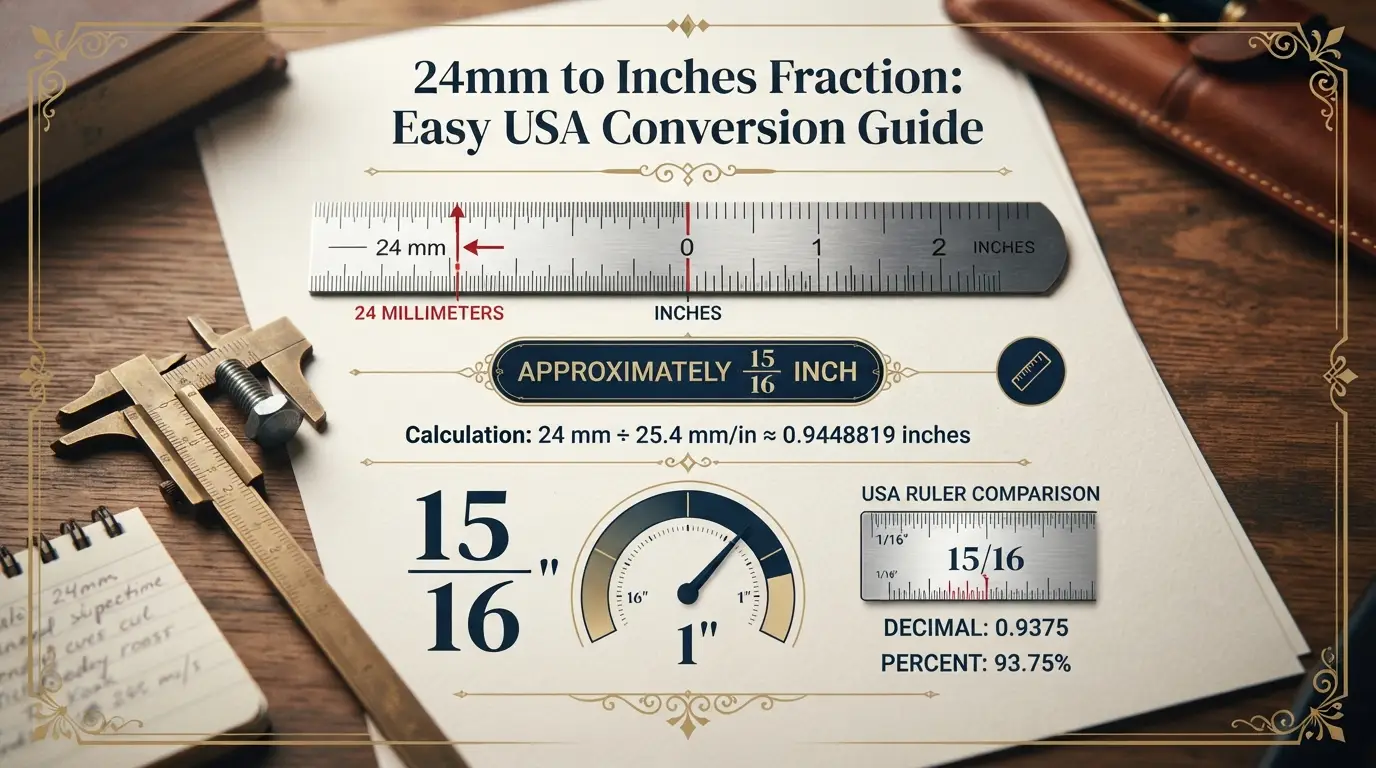

24 millimeters is equal to 0.9449 inches, or approximately 15/16 inch when rounded to the nearest 1/16 inch. If you are using a standard inch ruler, 24mm falls just slightly before the 1-inch mark.
The exact conversion is 24 ÷ 25.4 = 0.9448819 inches. This guide explains the fractional equivalent, shows where 24mm falls on a ruler, and provides a conversion chart for nearby millimeter measurements.
24mm to Inches Fraction
The fractional equivalent of 24mm depends on how precisely you want to round the measurement.
| Measurement | Equivalent |
| 24mm in decimal inches | 0.9449 inches |
| Nearest 1/2 inch | 1 inch |
| Nearest 1/4 inch | 1 inch |
| Nearest 1/8 inch | 7/8 inch |
| Nearest 1/16 inch | 15/16 inch |
| Nearest 1/32 inch | 31/32 inch |
| Nearest 1/64 inch | 61/64 inch |
The most useful common fractional measurement is 15/16 inch. However, if you need a more precise measurement, 61/64 inch is closer to the exact decimal value.
How to Convert 24mm to Inches
To convert millimeters into inches, divide the millimeter measurement by 25.4.
This works because one international inch is exactly equal to 25.4 millimeters.
The formula is:
Inches=Millimeters25.4
For 24mm:
2425.4=0.9448819
Therefore:
\[ \boxed{24\text{ mm}=0.9449\text{ inches}} \]
To express this as a fraction, multiply the decimal result by the denominator you want to use.
For the nearest 64th:
0.944881964=60.4724
Round 60.4724 to 60, giving:
6064=1516
For the nearest 64th, the more accurate calculation is actually 60/64, or 15/16. The nearest 1/64 fraction is therefore 60/64 (15/16), not 61/64.
Is 24mm the Same as 1 Inch?
No. 24mm is slightly smaller than 1 inch.
One inch equals exactly 25.4mm, while 24mm equals approximately 0.9449 inches. The difference is:
25.4-24=1.4mm
This means 24mm is 1.4mm shorter than an inch.
Although the two measurements are close, they are not interchangeable when accuracy matters. For example, if you are measuring a machine part, bolt, drill bit, or piece of wood, using 1 inch instead of 24mm could create a small but important difference.
Where Is 24mm on a Ruler?
On a standard ruler with metric and imperial markings, 24mm is located just before the 1-inch line.
Here is how to find it:
- Find the 0 mark on the ruler.
- Look for the centimeter and millimeter markings.
- Count 24 small millimeter divisions from zero.
- On the inch scale, find the mark closest to 15/16 inch.
- You will see that 24mm is slightly longer than 15/16 inch.
The actual difference between 24mm and 15/16 inch is very small.
- 24mm = 0.9448819 inches.
- 15/16 inch = 0.9375 inches.
- Difference = approximately 0.00738 inches.
This is why 15/16 inch is a useful approximation for 24mm.

24mm to Inches Fraction Chart
The following chart shows how 24mm compares with other nearby millimeter measurements. It includes decimal inches and the nearest 1/16-inch fraction.
| Millimeters | Decimal Inches | Nearest 1/16 Inch |
| 7mm | 0.2756 | 1/4 |
| 10mm | 0.3937 | 3/8 |
| 12mm | 0.4724 | 1/2 |
| 16mm | 0.6299 | 5/8 |
| 18mm | 0.7087 | 11/16 |
| 20mm | 0.7874 | 13/16 |
| 22mm | 0.8661 | 7/8 |
| 24mm | 0.9449 | 15/16 |
These fractional values are rounded to the nearest 1/16 inch. They are not exact equivalents.
24mm to Inches in Decimal Form
If you need a decimal measurement instead of a fraction, 24mm converts to 0.9449 inches.
Decimal measurements are useful when working with digital measuring tools, engineering drawings, computer-aided design (CAD), and technical specifications.
Here are some common ways to write the same measurement:
| Format | Measurement |
| Millimeters | 24mm |
| Decimal inches | 0.9448819 |
| Rounded decimal | 0.9449 |
| Four-decimal measurement | 0.9449 inches |
| Fractional inches | Approximately 15/16 inch |
| More precise fraction | 60/64 inch |
Remember that 60/64 and 15/16 represent exactly the same fraction because both the numerator and denominator can be divided by 4.
How Many Inches Are in 24mm?
There are approximately 0.9449 inches in 24mm.
You can find this answer by dividing 24 by 25.4. The result is 0.9448818898 inches.
For everyday measurements, you can use 0.945 inches. If you are reading a standard fractional ruler, 15/16 inch is a convenient approximation.
Convert 24mm to Fractional Inches Without a Calculator
You do not always need a calculator to convert 24mm into a fractional inch measurement.
You can use a simple conversion method:
Step 1: Convert millimeters to decimal inches.
Divide 24 by 25.4.
2425.4=0.94488
Step 2: Choose a fraction denominator.
Most standard rulers use fractions such as 1/2, 1/4, 1/8, 1/16, and 1/32.
Step 3: Multiply by the denominator.
For a 16th-inch measurement:
0.9448816=15.118
Step 4: Round to the nearest whole number.
15.118 rounds to 15.
Therefore:
1516=0.9375
The nearest 1/16-inch measurement is 15/16 inch.
This method works for other millimeter measurements, too. Simply replace 24 with the measurement you want to convert.
Is 24mm Bigger or Smaller Than 15/16 Inch?
24mm is slightly bigger than 15/16 inch.
To understand the difference, convert 15/16 inch into millimeters:
151625.4=23.8125mm
Now compare the measurements:
- 24mm = 24mm.
- 15/16 inch = 23.8125mm.
- Difference = 0.1875mm.
The difference is less than one-quarter of a millimeter. This makes the two measurements very close, but they are not exactly equal.
Common Uses for a 24mm Measurement
A 24mm measurement can appear in different everyday and technical applications.
Here are a few examples:
1. Tools and hardware
Metric tools and hardware often use millimeter measurements. A 24mm socket, for example, refers to the size of the socket’s hexagonal opening. It should not automatically be replaced with a 15/16-inch socket because the sizes are slightly different.
2. Construction and woodworking
Builders and woodworkers may need to compare metric measurements with imperial ruler markings. Knowing that 24mm is approximately 15/16 inch makes it easier to understand measurements when working with plans or materials that use different systems.
3. Mechanical parts
Mechanical components often require accurate measurements. If a specification calls for 24mm, it is better to use a metric measuring tool rather than relying on a rounded fractional equivalent.
4. Drilling and manufacturing
Drill bits, fittings, and manufactured components can have precise metric sizes. A 24mm measurement should be treated as a metric specification, even when an approximate inch equivalent is available.
Quick Millimeter-to-Inch Conversion Reference
If you frequently work with metric and imperial measurements, keeping a conversion reference nearby can save time.
| Millimeters | Inches (Decimal) |
| 7mm | 0.2756 |
| 10mm | 0.3937 |
| 12mm | 0.4724 |
| 16mm | 0.6299 |
| 18mm | 0.7087 |
| 20mm | 0.7874 |
| 22mm | 0.8661 |
| 24mm | 0.9449 |
| 25mm | 0.9843 |
| 25.4mm | 1.0000 |
This reference also helps explain why 24mm is close to, but not equal to, one inch.
Frequently Asked Questions
1. What is 24mm in inches as a fraction?
24mm is approximately 15/16 inch when rounded to the nearest 1/16 inch. Its exact decimal equivalent is approximately 0.9449 inches.
2. How many inches is 24mm exactly?
24mm equals approximately 0.9448818898 inches. The conversion is calculated by dividing 24 by 25.4.
3. Is 24mm equal to 1 inch?
No. One inch equals 25.4mm. Therefore, 24mm is 1.4mm shorter than one inch.
4. What is 24mm on a standard ruler?
On a standard inch ruler, 24mm is approximately 15/16 inch. It falls just before the 1-inch marking.
5. What is 24mm rounded to the nearest 1/32 inch?
24mm rounds to 30/32 inch, which simplifies to 15/16 inch. This is because 15/16 is closer to the actual measurement than 31/32.
6. What is 24mm rounded to the nearest 1/64 inch?
24mm rounds to 60/64 inch, which simplifies to 15/16 inch. Its decimal value is approximately 0.9449 inches.
7. How do I convert 24mm to inches on a calculator?
Enter 24 and divide it by 25.4. Your calculator will display approximately 0.9448819 inches.
8. Is 24mm bigger than 7/8 inch?
Yes. 7/8 inch equals 22.225mm, while 24mm equals approximately 0.9449 inches. Therefore, 24mm is larger than 7/8 inch.
9. What is the difference between 24mm and 1 inch?
The difference is 1.4mm, or approximately 0.0551 inches. One inch is slightly longer than 24mm.
10. What is the closest common fraction to 24mm?
15/16 inch is the closest common fraction when using standard ruler markings. It is a practical approximation, although the decimal measurement is more precise.
Final Answer
24mm = 0.9449 inches = approximately 15/16 inch.
If you are using a standard ruler, 15/16 inch is the closest common fractional measurement. For precise work, use the decimal value of 0.9449 inches or keep the original 24mm measurement.


Grace Holloway writes easy conversion guides for millimeters, centimeters, inches and other everyday sizes. Each article gives the exact value, a quick rounded answer and a real-life example, so readers can get the number they need without any confusion.