

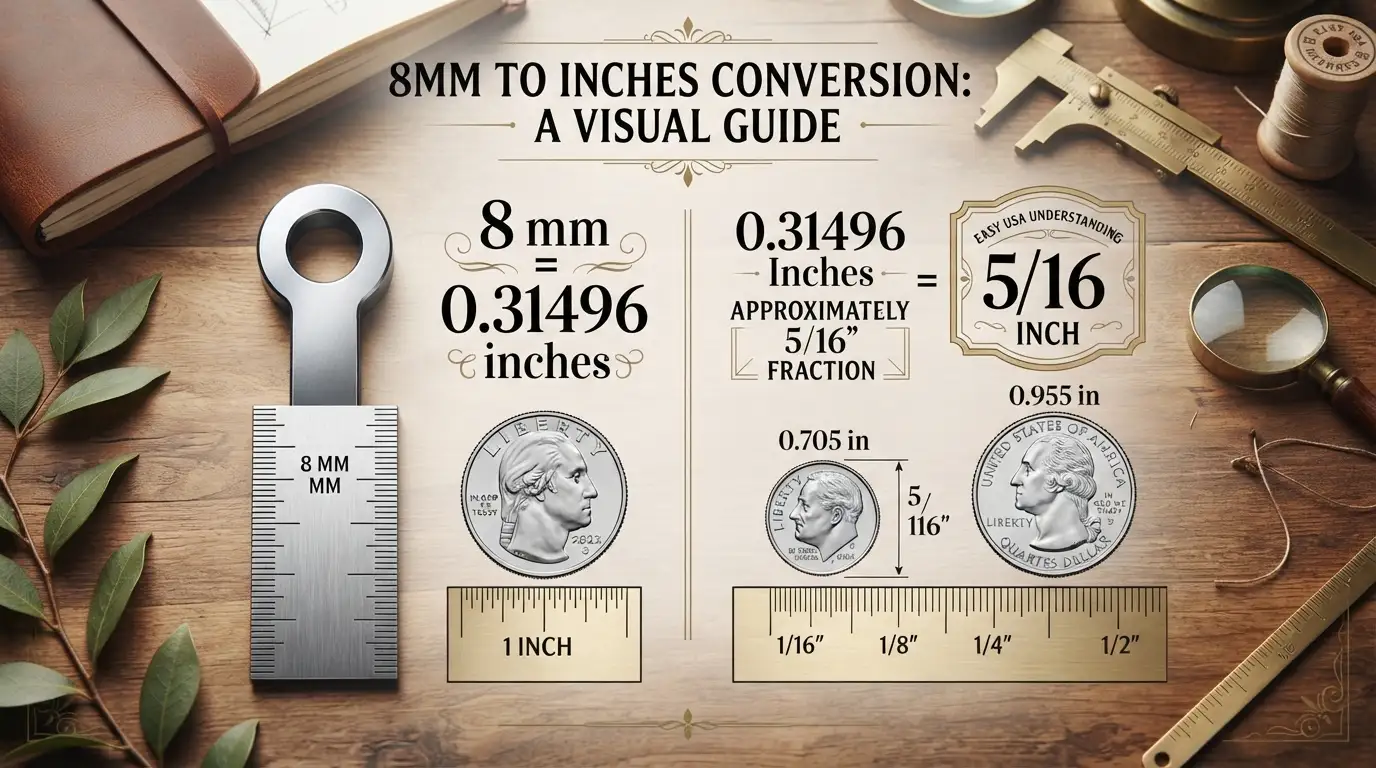
8mm is equal to 0.315 inches, which is closest to 5/16 inch on a standard fractional inch ruler.
If you are converting millimeters to inches for a drill bit, socket, ruler, or another measuring tool, the closest fractional equivalent is usually what you need.
Here are the most important values:
- 8mm = 0.31496 inches
- Decimal rounded to three places = 0.315 inches
- Closest common fraction = 5/16 inch
- 5/16 inch = 7.9375mm
Although 8mm and 5/16 inch are very close, they are not exactly the same measurement. The difference is only 0.0625mm.

8mm to Inches Fraction Conversion
To convert 8mm into a fraction of an inch, first convert millimeters into decimal inches. Then find the closest common fraction.
825.4=0.3149606
The decimal result is approximately 0.315 inches.
When rounded to the nearest 1/16 inch, the result is:
\[ \boxed{8mm \approx 5/16\text{ inch}} \]
The fraction 5/16 is a convenient measurement for reading a standard ruler or comparing common tool sizes.
| Measurement | Result |
| 8mm in decimal inches | 0.31496 in |
| Rounded decimal | 0.315 in |
| Closest 1/16 fraction | 5/16 in |
| Closest 1/32 fraction | 10/32 in |
| Closest 1/64 fraction | 20/64 in |
Important: 5/16 inch is the closest common fraction, not the exact mathematical fraction. The exact conversion is 40/127 inches.
How to Convert 8mm to Inches
The easiest way to convert millimeters into inches is to divide the millimeter measurement by 25.4.
There are 25.4 millimeters in one inch. This number is the standard conversion factor.
Use this formula:
Inches=Millimeters25.4
For an 8mm measurement:
825.4=0.3149606
Therefore:
8mm=0.3149606inches
To express this as a familiar ruler fraction, compare the decimal result with common fractions. The closest 1/16-inch measurement is 5/16 inch.
This same formula works for 4mm, 5mm, 6mm, 7mm, 10mm, 12mm, and 16mm.
8mm to Inches Conversion Chart
If you regularly work with metric measurements, a conversion chart can save time. It lets you compare millimeters with decimal inches and familiar fractions without repeating the calculation.
The following chart includes the most commonly searched measurements related to 8mm to inches fraction conversions.
| Millimeters | Decimal Inches | Closest Fraction |
| 4mm | 0.1575 | 5/32 inch |
| 5mm | 0.1969 | 3/16 inch |
| 6mm | 0.2362 | 15/64 inch |
| 7mm | 0.2756 | 9/32 inch |
| 8mm | 0.3150 | 5/16 inch |
| 10mm | 0.3937 | 25/64 inch |
| 12mm | 0.4724 | 15/32 inch |
| 16mm | 0.6299 | 5/8 inch |
Fractions in this chart are rounded to the nearest 1/64 inch. They are approximate equivalents, not exact metric conversions.
8mm to Inches Fraction on a Ruler
If you have a standard inch ruler, you can use it to find the approximate location of 8mm.
First, remember that 8mm is approximately 0.315 inches. On an inch ruler, this measurement falls just slightly below the 5/16-inch mark.
Here is how to find it:
- Find the zero mark on your inch ruler.
- Look for the 5/16-inch mark.
- Understand that 5/16 inch equals 0.3125 inches.
- The exact 8mm measurement is 0.31496 inches.
- Therefore, 8mm falls just a little beyond the 5/16-inch mark.
The difference is extremely small, so 5/16 inch is a useful reference when measuring everyday objects.
However, if you need an exact measurement for machining, engineering, or a precision project, use a metric ruler or digital caliper instead of relying on the rounded fraction.

Is 8mm the Same as 5/16 Inch?
No. An 8mm measurement and a 5/16-inch measurement are very close, but they are not exactly equal.
Let’s compare them:
- 8mm = 0.31496 inches
- 5/16 inch = 0.3125 inches
- Difference = 0.00246 inches
In millimeters, 5/16 inch equals 7.9375mm.
This means 8mm is slightly larger than 5/16 inch.
For everyday measurements, the difference is usually small enough that people use these sizes as approximate equivalents. For precision work, however, you should not treat them as identical.
8mm to Inches in 32nds
Some rulers display measurements in 32nds of an inch instead of 64ths.
To convert 8mm into 32nds, multiply its decimal inch value by 32.
0.314960632=10.0787
The nearest whole number is 10.
Therefore:
8mm1032=516
So, 8mm is approximately 10/32 inch, which simplifies to 5/16 inch.
This is useful when working with rulers that have 32 equally spaced divisions in each inch.
What Is an 8mm Drill Bit in Inches Fraction?
An 8mm drill bit is approximately 5/16 inch in fractional size.
This is the closest common fractional drill bit size to 8mm. If you are comparing drill bits in a toolbox, 5/16 inch is the size you will most often want to compare with an 8mm bit.
However, the two bits have slightly different diameters:
| Drill Bit Size | Diameter in Inches | Diameter in Millimeters |
| 8mm drill bit | 0.31496 in | 8mm |
| 5/16-inch drill bit | 0.3125 in | 7.9375mm |
The 8mm drill bit is approximately 0.0625mm larger than the 5/16-inch drill bit.
For ordinary projects, these sizes may be close enough depending on the material and required fit. For precise holes, use the exact drill bit size specified in your project instructions.
Is 8mm a Common Drill Bit Size?
Yes. An 8mm drill bit is a common metric size used for drilling holes in wood, metal, plastic, and other materials.
When a project specifies an 8mm hole, the best choice is an actual 8mm drill bit.
A 5/16-inch bit may be a close alternative, but it is not exactly the same size. Always check the required hole diameter before choosing a replacement.
Is an 8mm Socket the Same as a Fractional Socket?
An 8mm socket is a metric tool size. Its approximate fractional equivalent is 5/16 inch.
However, this does not mean an 8mm socket and a 5/16-inch socket are interchangeable in every situation.
An 8mm socket is designed for fasteners with an 8mm measurement across the flats. A 5/16-inch socket is designed for a fastener measuring 5/16 inch across the flats.
The difference is small, but it can matter when working with fasteners.
For the best fit:
- Use an 8mm socket for an 8mm fastener.
- Use a 5/16-inch socket for a 5/16-inch fastener.
- Avoid forcing a socket onto a fastener that does not fit properly.
This helps prevent rounded edges, damaged fasteners, and unnecessary wear on your tools.

Comparing 8mm with Other Millimeter Measurements
People searching for 8mm to inches fraction often need to convert nearby metric sizes as well. These conversions are useful when comparing rulers, drill bits, sockets, screws, and other hardware.
Here are the conversions for the most common related measurements.
10mm to Inches Fraction
10mm equals approximately 0.3937 inches. Its closest 1/64-inch fraction is 25/64 inch.
1025.4=0.3937
This measurement is slightly smaller than 13/32 inch (0.40625 inches).
6mm to Inches Fraction
6mm equals approximately 0.2362 inches. Its closest 1/64-inch fraction is 15/64 inch.
625.4=0.2362
This is a useful conversion when comparing small metric measurements with an inch ruler.
12mm to Inches Fraction
12mm equals approximately 0.4724 inches. Its closest 1/64-inch fraction is 15/32 inch.
1225.4=0.4724
It is slightly smaller than 1/2 inch.
7mm to Inches Fraction
7mm equals approximately 0.2756 inches. Its closest 1/64-inch fraction is 9/32 inch.
725.4=0.2756
4mm to Inches Fraction
4mm equals approximately 0.1575 inches. Its closest 1/64-inch fraction is 5/32 inch.
425.4=0.1575
5mm to Inches Fraction
5mm equals approximately 0.1969 inches. Its closest 1/64-inch fraction is 13/64 inch.
525.4=0.1969
It is also close to 3/16 inch, which is a commonly used fraction on standard rulers.
16mm to Inches Fraction
16mm equals approximately 0.6299 inches. Its closest 1/64-inch fraction is 5/8 inch.
1625.4=0.6299
These conversions make it easier to compare metric and imperial measurements without starting from zero every time.
How to Find the Closest Fraction for Any Millimeter Measurement
You do not need a special calculator to find the closest fractional inch measurement. You can use a simple calculation.
Follow these steps:
Step 1: Convert millimeters into decimal inches.
Divide the millimeter measurement by 25.4.
Step 2: Choose the fraction denominator.
Common ruler divisions include 8, 16, 32, and 64.
Step 3: Multiply the decimal result by the denominator.
For example, with 8mm and a denominator of 64:
0.314960664=20.1575
Step 4: Round to the nearest whole number.
20.1575 rounds to 20.
Step 5: Write the fraction.
2064=516
Therefore, 8mm is approximately 5/16 inch.
This method works for almost any millimeter measurement.
Why Do People Convert Millimeters to Fractional Inches?
Millimeters and inches are both used to measure length, but they belong to different measurement systems.
Millimeters are part of the metric system, while inches are part of the imperial measurement system.
In the United States, many rulers, woodworking tools, construction materials, and hardware products use inches. However, many products and technical specifications use millimeters.
Converting between these units helps when:
- Comparing metric and imperial drill bits.
- Measuring screws, bolts, and other fasteners.
- Reading a ruler with fractional inch markings.
- Working with woodworking or metalworking projects.
- Checking product dimensions.
- Following instructions that use different measurement systems.
For example, if a project requires an 8mm hole but your measuring reference uses inches, knowing that 8mm is approximately 5/16 inch makes the measurement easier to understand.
Common Mistakes When Converting 8mm to Inches
A few small mistakes can lead to incorrect measurements. Keep these points in mind when converting 8mm into inches.
1. Treating 5/16 inch as an exact conversion
5/16 inch is a close approximation of 8mm, not the exact equivalent. The exact result is 40/127 inches.
2. Using the wrong conversion factor
One inch equals 25.4mm. Always divide millimeters by 25.4 when converting to inches.
3. Confusing decimal inches with fractional inches
0.315 inches is a decimal measurement. 5/16 inch is a fractional measurement. Both describe approximately the same length, but they use different formats.
4. Rounding too early
Keep several decimal places during calculations. Round only when you have the final result.
5. Assuming metric and imperial tools are interchangeable
An 8mm drill bit and a 5/16-inch drill bit have slightly different diameters. This difference can matter in precision work.
Frequently Asked Questions
1. What is 8mm in inches?
8mm equals 0.31496 inches. Rounded to three decimal places, it is 0.315 inches.
2. What fraction is closest to 8mm?
The closest common fractional inch measurement is 5/16 inch. It is slightly smaller than 8mm.
3. Is 8mm equal to 5/16 inch?
No. 8mm equals 0.31496 inches, while 5/16 inch equals 0.3125 inches. They are very close but not exactly equal.
4. What is 8mm in inches on a ruler?
On a standard inch ruler, 8mm falls just beyond the 5/16-inch mark. The difference is very small.
5. What is 8mm in 32nds of an inch?
8mm is approximately 10/32 inch. This fraction simplifies to 5/16 inch.
6. What is the exact fraction of 8mm in inches?
The exact mathematical fraction is 40/127 inch. The commonly used approximate fraction is 5/16 inch.
7. What is an 8mm drill bit in fractional inches?
An 8mm drill bit is closest to a 5/16-inch drill bit. However, the 8mm bit is slightly larger.
8. What is 8mm in decimal inches?
8mm equals 0.3149606299 inches. You can round this to 0.315 inches for everyday use.
9. How many inches are in 10mm?
10mm equals approximately 0.3937 inches. Its closest 1/64-inch fraction is 25/64 inch.
10. How many inches are in 6mm?
6mm equals approximately 0.2362 inches. Its closest 1/64-inch fraction is 15/64 inch.
11. How many inches are in 12mm?
12mm equals approximately 0.4724 inches. Its closest 1/64-inch fraction is 15/32 inch.
12. How do I convert millimeters to inches?
Divide the millimeter value by 25.4. For example, 8 divided by 25.4 equals 0.31496 inches.
Final Answer
8mm is equal to 0.31496 inches, or approximately 5/16 inch. This is the closest common fractional inch measurement. For precise work, remember that 8mm is slightly larger than 5/16 inch.


Grace Holloway writes easy conversion guides for millimeters, centimeters, inches and other everyday sizes. Each article gives the exact value, a quick rounded answer and a real-life example, so readers can get the number they need without any confusion.